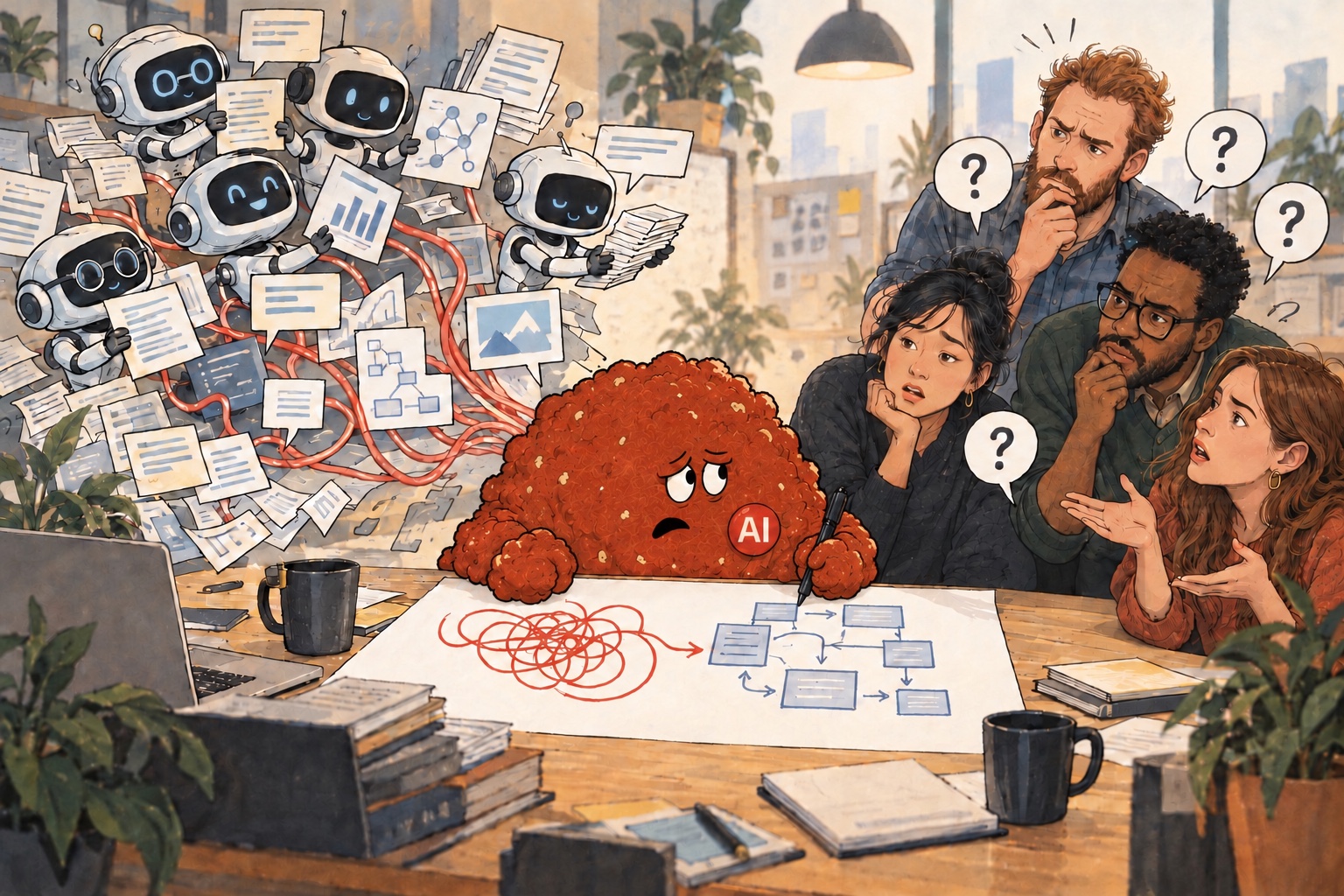
Someone put a scarlet letter on me in a work Slack channel.
The letter was AI.
It was the middle of the week, and we were working under crazy deadlines on a large cross-functional program. I was juggling design and requirements reviews, questions moving between customers, subject-matter experts and engineering, and the long Slack discussions required to keep everything moving.
Agents were helping me survive. They summarized meetings, tracked follow-ups, helped me reason through questions, and drafted responses. In one of those discussions, I needed to explain a requirement from a product requirements document (PRD) I had written. My agent drafted a response. I read it, thought it made sense, and sent it.
An engineer replied that it was hard to understand and sounded like something an AI had written that the author hadn't bothered to read.
Publicly.
That made me feel like shit.
My first defense, at least inside my own head, was: But I did read it.
I wasn't trying to hide that I used AI. I had read the response. I understood the words. I thought it was clear.
But my whole job is communicating. I am supposed to understand what customers need, figure out what we should build, and help engineers, designers, subject-matter experts, and leaders understand it well enough to make decisions and get it done. This didn't feel like criticism of one Slack message. It felt like being called out as bad at my job.
And the worst part was that he was right.
When I tried to explain the requirement myself—what the customer actually needed and why—I couldn't get beyond what was already written in the PRD.
I didn't understand it.
I understood enough to trust the agent's response. I had let it do the thinking, reasoning, and communicating, and then put my name on the result.
I wanted agents to become an extension of me.
Somewhere along the way, I had become an extension of them.
A meat proxy.
I needed five Michaels
I hadn't set out to outsource my understanding. I was trying to survive a completely different job.
After a reorganization, my team was gone. The people disappeared, but most of the work and expectations remained. I went from leading a team to operating as an individual contributor across a large program in a domain I was still learning, with dozens of PRDs to produce on an aggressive deadline.
Making my writing 20% better wasn't the problem anymore.
I needed five more versions of myself.
At first, my use of AI had been fairly ordinary. I would write a document or Slack message, paste it into ChatGPT, and ask it to clean up my work. I realize using a chatbot to edit Slack messages is a little ridiculous and probably wasn't saving me much time. But I liked it. It felt like having a second set of eyes that made what I wanted to say a little clearer.
The new job required something different. I didn't just need an editor. I needed help doing work that had previously been spread across a team: customer research, requirements, data analysis, technical investigation, stakeholder management, program management, prioritization, and communication.
So I moved more of my work into an agent environment and started building a knowledge repository: a collection of Markdown files, skills, instructions, and context that could help an agent behave more like a product manager. If I gave it enough information about customers, meetings, objectives, prior decisions, and the people involved, maybe any new session could pick up the work and think more like I would.
It worked.
Sort of.
AI helped me get through an enormous amount of work (Claude Code is my boy!).
But I had also created a new job for myself: managing the agents.
Before, I might start a day by opening a document, reading where I left off, and continuing. Now I could have 11 terminals open with different agent sessions. Which one knew what? What needed to be saved? When should I start a new session? What belonged in long-term memory versus the context for a particular task? What happened when a tool changed, a workflow broke, or the knowledge base became unreliable?
Every new capability exposed another problem and inspired another system to solve it. Then I had to build, learn, maintain, and remember that system while still doing my actual job.
I wanted five brains.
Now I had to manage five brains.
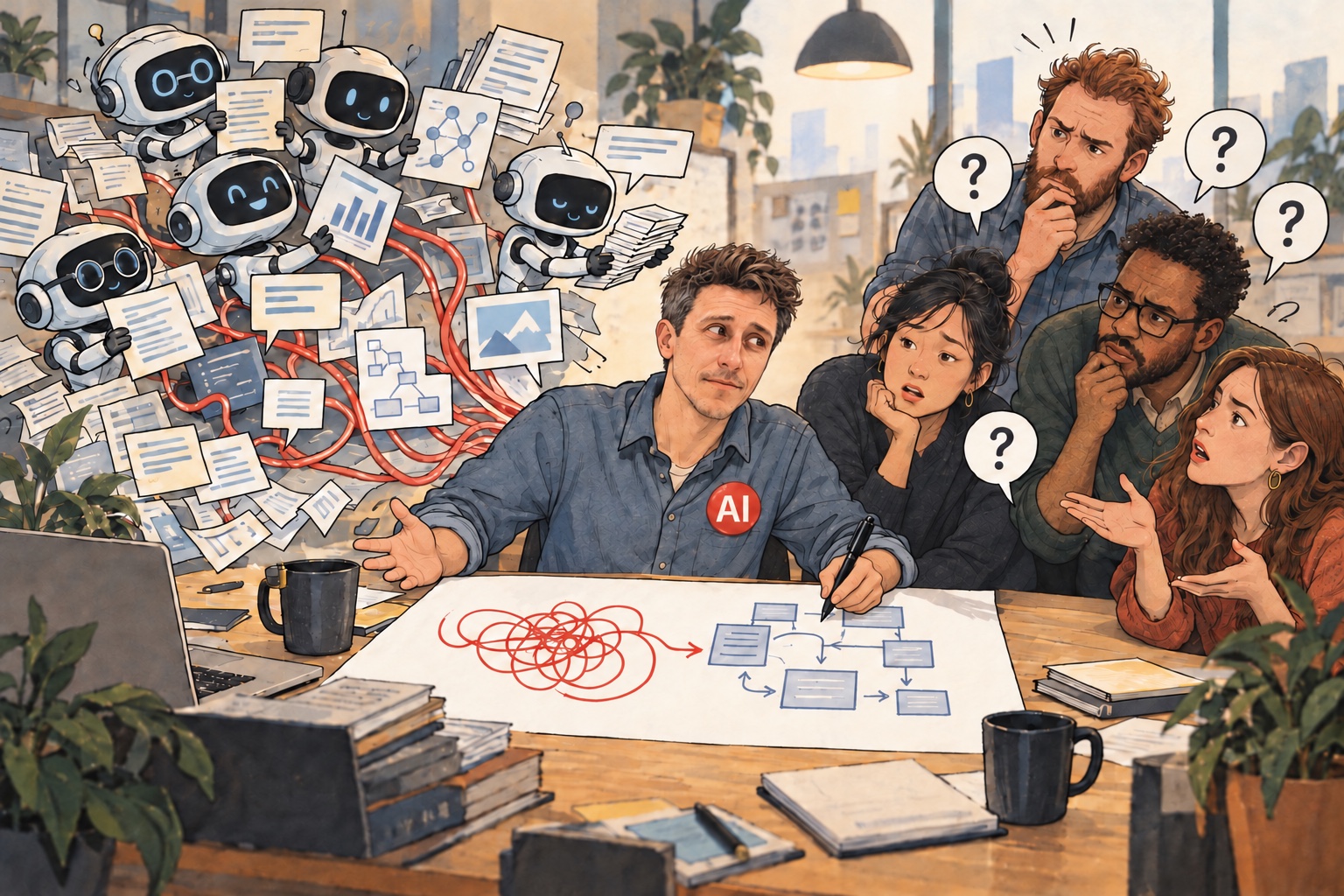
The document can get better while I don't
The coordination tax was frustrating, but it wasn't the deepest problem.
Writing the PRD isn't the job.
An agent can produce a correct, polished document. Someone still has to understand it. Someone has to talk to customers and subject-matter experts, work through disagreements with engineering and design, make judgments when the facts are incomplete, and explain why the requirement exists.
For the PRDs I had generated, that responsibility still belonged to me.
Normally, the iterations are how I learn. A conversation changes my understanding. That changes the document. The new document creates another conversation. Over time, both the work and my understanding improve.
But agents could now handle more of those iterations for me. They could collect the feedback, update the PRD, draft the follow-up, and keep the workflow moving.
The document could get better while I didn't.
That was what the Slack message exposed. I had reviewed the output without developing the understanding required to own it. The problem wasn't that an agent had helped me write. The problem was that I couldn't explain what I was responsible for explaining.
A better version of the partnership
More recently, one of those PRDs became blocked on a data dependency.
In the past, I might have asked agents to identify the owners, coordinate follow-ups, and update the PRD as answers came in. The document would improve. The workflow might even keep moving. I could still remain one level removed from the thing I was supposed to understand.
This time, I spent two or three days going back and forth with my agents. We dug out the responsible people, requirements, systems, and data flows. The flow was much more complicated than the PRD made it appear.
Then I had the agents help create a slide deck with visuals and clear tables showing only what mattered to the people involved.
The point wasn't the deck. Deciding what belonged in it forced me to understand the dependency well enough to explain it. I had to question the analysis, simplify the flow, notice what was missing, and decide what other people needed to know.
By the time we were done, I could walk into the conversation, explain the problem, and help the teams make a decision. We unblocked the work and met the deadline.
The agents had still done a tremendous amount. They found information, organized it, suggested structures, and helped create the explanation. But we had worked back and forth until their work became my understanding.
That is the partnership I want: agents and me working in harmony to communicate clearly with other people—and with other agents. They should extend my ability to learn about customers, technology, markets, and financials, and help me turn that understanding into action. They shouldn't create more work that I can approve but cannot explain.
Generative friction
I have started calling the useful part of that back-and-forth generative friction.
Most software tries to eliminate friction. Writing tools promise to get us from an idea to polished prose with fewer steps. Agents go further: they can research, reason, draft, revise, and sometimes deliver the work while we do something else.
Some friction deserves to disappear. I don't become a better thinker by fixing transcription errors, reformatting tables, or hunting through 11 sessions for a fact an agent already found.
But some friction is the work.
It is the question that makes me realize I don't understand the customer need. The diagram that exposes a broken assumption. The attempt to explain a requirement that reveals I have only been repeating the document. The disagreement that forces me to decide what I actually believe.
The useful loop looks something like:
Articulate → get questioned → investigate → explain → discover a gap → articulate again.
That is different from:
Agent produces → I review → I approve → someone else tries to understand.
I originally phrased the distinction too neatly: if AI supplies the substance, I am probably skipping the hard part; if AI causes me to produce more substance, I am probably doing the hard part.
The work examples complicate that. Agents should supply substance. They can find facts I missed, propose an argument I hadn't considered, analyze data faster than I can, and help me see a problem differently.
The better test is what happens to me through the interaction.
Can I explain it? Can I judge whether it is right? Can I adapt it when the situation changes? Can I take responsibility for the decision? Did the collaboration leave me with more understanding than I started with?
Good friction develops that capacity. Bad friction is administrative: maintaining another harness, answering questions that don't matter, or editing polished prose before I have figured out what I mean.
The goal isn't maximum friction. It is to spend friction where understanding and judgment are at stake, and automate where they aren't.
The same problem followed me home
Writing is central to my professional life, but I have wanted to write publicly for probably eight years and basically haven't.
Writing is expensive. After spending eight to twelve hours thinking and communicating for work, then spending time with my family, it is hard to imagine sitting down at 9 PM and rigorously working through an essay about something else I care about.
AI seemed like an obvious solution.
I dictated a bunch of thoughts about AI and writing into ChatGPT. After a few rounds of back-and-forth, it turned them into an essay. It looked good. Maybe 90% of the way to something I would feel comfortable publishing.
So I put it in a Google Doc and sat down to finish it.
Then I got writer's block.
The prose was clear. I mostly agreed with it. But instead of feeling like I was finishing something I had written, I felt like I was editing someone else's solution. One paragraph was thin, but the polished prose made it difficult to see what was missing.
So I stopped trying to fix the paragraph and started talking about why it bothered me.
Suddenly I had a lot to say.
I talked about studying biology and how the scientific method shaped the way I approach product management. I talked about why writing matters in product work. I talked about the cost of doing more writing after a full day of knowledge work. Those ideas were missing from the draft because I hadn't articulated them yet.
The bad paragraph had caused me to find them.
So we changed the workflow. Instead of asking AI to improve the essay, I asked it to act like a developmental editor. It left questions in the document. I answered them by dictating. It read my answers and asked fewer, deeper questions. I dictated again.
And something surprising happened.
It was fun.
The questions created friction in exactly the places where I still needed to think. Each answer gave me more material and a clearer understanding of what I wanted to say. The experience felt remarkably similar to working through the data dependency: explain, get questioned, discover a gap, investigate, explain again.
The output improved because my understanding improved.

The experiment
That leaves me with a question I didn't expect when I started:
Can AI make me a better writer without replacing the part of writing that makes me think?
For me, success is concrete. I will actually write and publish. The writing will sound like me. The thinking will be mine. Not because an AI never contributed an idea or sentence, but because I engaged deeply enough to understand, judge, and own what we produced together.
And by doing that repeatedly, I should become a better writer and thinker myself.
I am building an open-source experiment around that idea. I am calling it Voice Kit.
Voice Kit isn't supposed to keep AI at arm's length. I want the leverage. I want agents that can research faster than I can, analyze information, critique my work, remember context, and help me communicate. I want them to extend what I can do.
But I also want the collaboration to keep me learning—to make me more capable of understanding customers, technology, markets, financials, and people at the new pace the work demands.
Maybe the goal isn't to stop being a meat proxy.
Maybe it is to become the best meat proxy I can be.
At least one who can explain the requirement.